Amir Simon · 26 September 2026
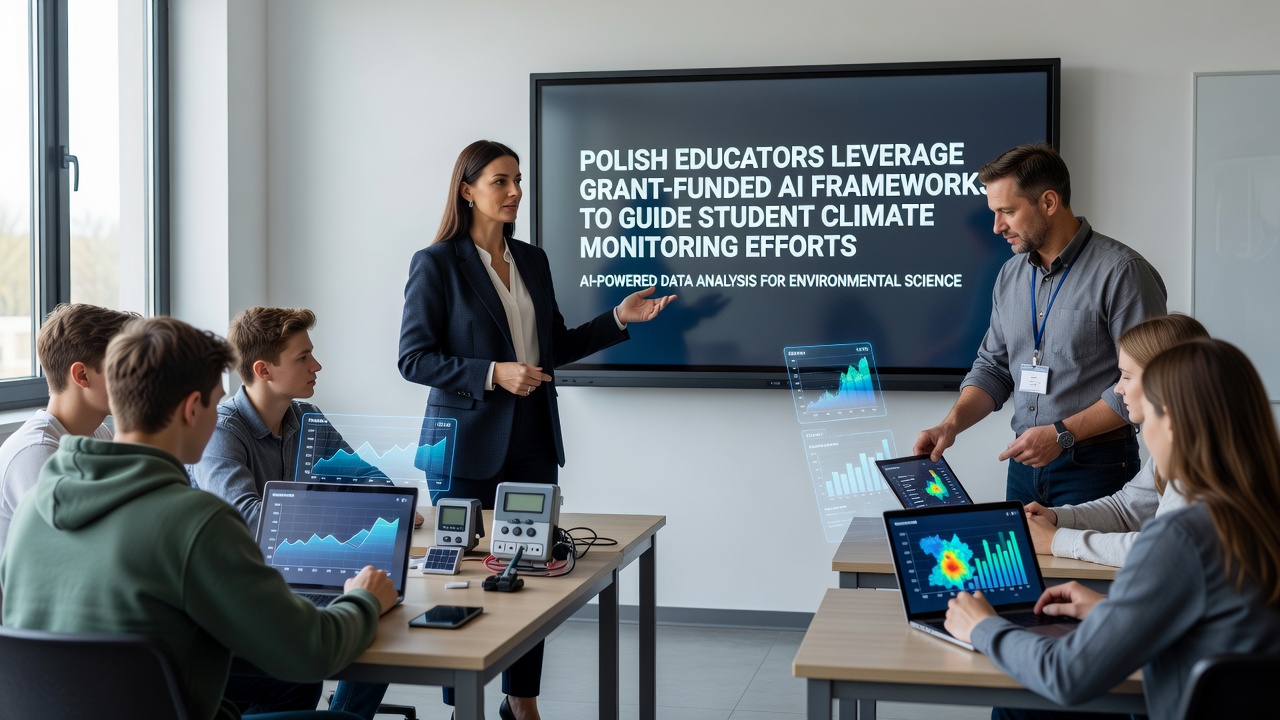
Polish Educators Leverage Grant-Funded AI Frameworks to Guide Student Climate Monitoring Efforts
Schools across Poland have integrated grant-supported artificial intelligence systems into climate monitoring projects that involve students directly in data collection and analysis, with several programs expanding operations as of September 2026. These initiatives draw on funding from European Union sources and national education allocations to equip classrooms with sensor networks, machine learning models, and visualization platforms that track local environmental variables such as temperature fluctuations, air quality indices, and precipitation patterns.
Educators coordinate with regional research centers to adapt open-source AI frameworks originally developed for agricultural forecasting, and students input field measurements that refine predictive algorithms over successive academic terms. Data from these efforts feed into centralized repositories managed by participating universities, where cross-validation against satellite records occurs on a monthly cycle.
Funding Mechanisms and Program Structure
Grant applications submitted through the Polish Ministry of Education and Science have secured multi-year support packages that cover hardware procurement, teacher training modules, and software licensing fees. One allocation round completed in late 2025 distributed resources to 47 secondary institutions, enabling deployment of low-cost IoT devices alongside cloud-based analytics dashboards. The structure requires participating schools to submit quarterly progress reports that detail student participation rates alongside metric accuracy benchmarks.
Training sessions for instructors emphasize integration of AI outputs with standard geography and biology curricula, while avoiding disruption to existing lesson plans. Coordinators from the National Centre for Research and Development oversee compliance with data privacy protocols established under EU directives, ensuring student-collected information remains anonymized during transmission to external servers.
Student Roles in Data Gathering and Interpretation
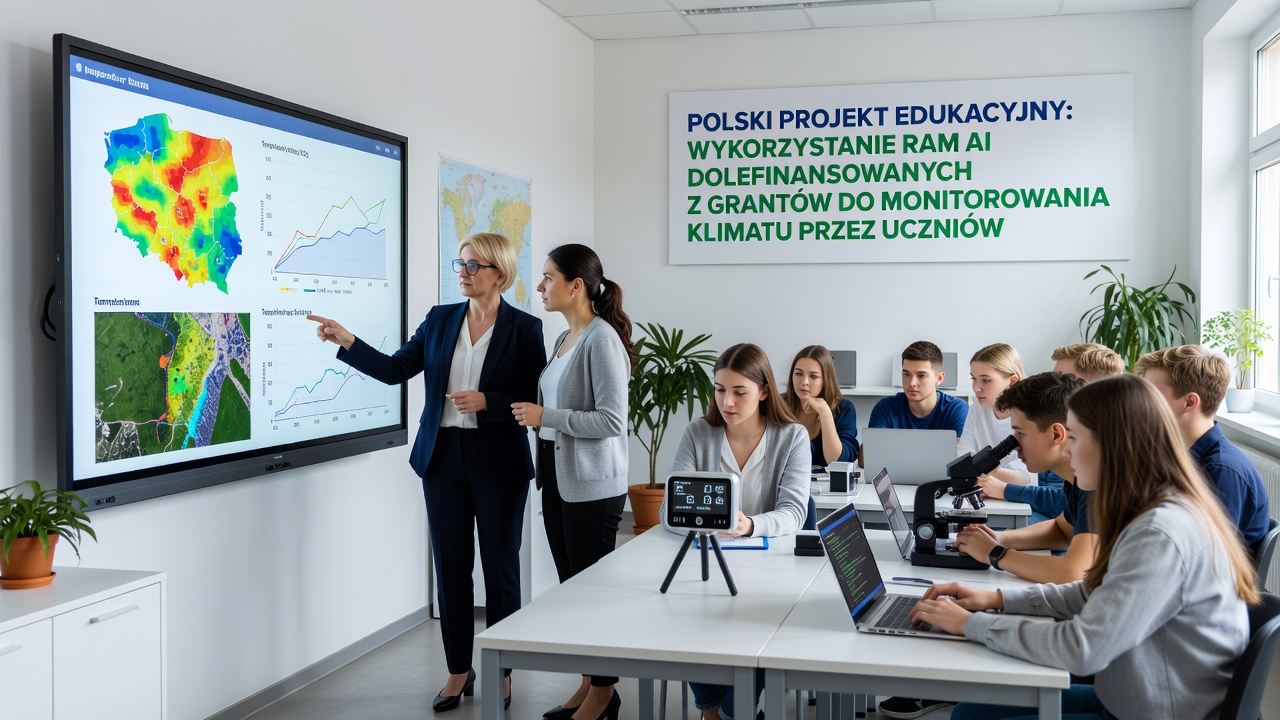
Participants begin with basic calibration of ground sensors placed on school grounds or nearby parks, recording variables at set intervals before uploading readings through secure applications. AI models then process these inputs to identify anomalies, such as unexpected spikes in particulate matter or deviations from historical seasonal norms, and generate alerts that prompt follow-up investigations by student teams. In several documented cases, groups have compared their localized findings with broader datasets from the Copernicus Climate Change Service to contextualize regional trends.
Advanced modules allow older students to adjust model parameters under supervision, testing how alterations in weighting factors affect projection reliability. This hands-on component has produced supplementary datasets on microclimate variations within urban versus rural school districts, with results presented at inter-school conferences held each spring.
Technical Components of the AI Frameworks
The core platforms rely on convolutional neural networks trained initially on European weather station archives, then fine-tuned with incoming Polish school data to improve localization. Integration with geographic information systems permits mapping of monitored sites, while natural language processing tools summarize findings into student-accessible reports. Hardware setups typically include Raspberry Pi units paired with calibrated sensors for temperature, humidity, and carbon dioxide levels, chosen for their durability and compatibility with existing school networks.
Updates to the frameworks occur through collaborative repositories hosted by partner institutions, incorporating feedback loops that incorporate validation from meteorological agencies. Observers note that accuracy rates for precipitation predictions have improved by measurable margins after incorporation of student-sourced inputs, according to internal evaluations shared among project leads.
Partnerships and Broader Applications
Collaborations extend to entities such as the European Environment Agency, which provides standardized metadata protocols, and selected academic departments at institutions outside the EU that contribute comparative climate modeling techniques. One partnership with Australian research groups has supplied algorithms refined on Southern Hemisphere datasets, allowing Polish teams to benchmark their models against different climatic zones. These exchanges occur via virtual workshops scheduled quarterly, with shared code repositories facilitating direct implementation of tested modules.
Community outreach components encourage students to present aggregated results at local environmental forums, linking classroom outputs to municipal planning discussions on adaptation measures. Records indicate that several municipalities have referenced school-generated maps when evaluating green infrastructure proposals.
Conclusion
Expansion of these AI-supported monitoring programs continues through 2026 and beyond, with additional grant cycles anticipated to incorporate primary schools and vocational tracks. The combination of structured funding, teacher preparation, and iterative model refinement sustains ongoing student engagement while generating verifiable environmental records that supplement national monitoring networks. Continued evaluation by overseeing bodies will determine scalability across further regions based on performance metrics collected to date.